MQTT Rule Engine in Rust — Architecture, SQL Syntax & Benchmarks
An MQTT rule engine processes, transforms, and routes MQTT message streams in real time. Rather than sending all raw sensor messages to a central cloud, the rule engine runs directly on the edge gateway. It evaluates SQL rules as each message arrives, sends alerts in sub-milliseconds, and summarizes telemetry before transmitting it upstream.
rekuiper is a single-binary MQTT rule engine and streaming SQL processor written in Rust. It provides deterministic tail latency, a flat 4.4 to 10.2 MiB heap memory profile under load, and sustained throughput of 150,000 to 200,000 messages per second on a single physical CPU core.
1. Architecture Overview
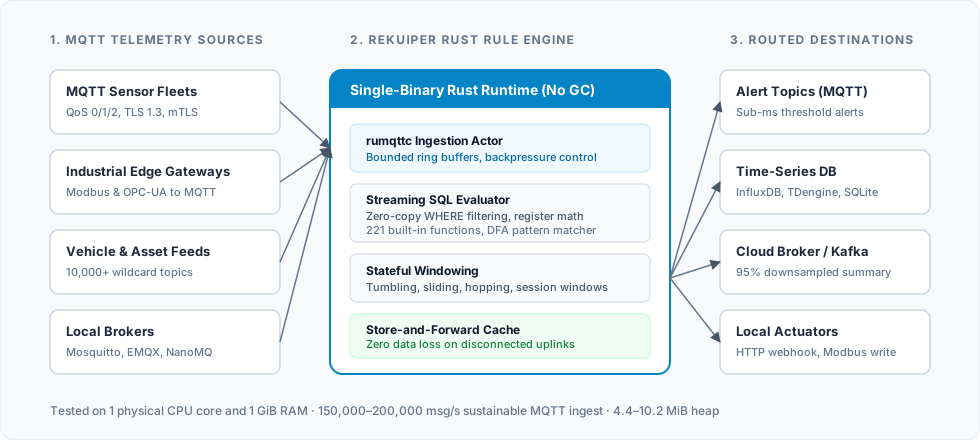
The following diagram illustrates how messages flow from MQTT publishers through the rekuiper engine to target destinations:
Pipeline Stages
- Network Ingestion Actor: Built on
rumqttc, the ingestion layer manages persistent TCP/TLS connections to one or more MQTT brokers (MQTT v3.1.1 and v5.0). It subscribes to topic hierarchies with single-level (+) and multi-level (#) wildcards. - Bounded Channel Ring Buffers: Ingested messages enter fixed-capacity ring buffers. When downstream processing slows down, bounded channels apply backpressure upstream, preventing unbounded heap growth and out-of-memory crashes.
- Zero-Copy Stream Evaluator: The SQL engine evaluates
WHEREpredicates directly on borrowed payload bytes. Numeric operations evaluate through CPU register fast-paths (try_eval_numeric_fast) without intermediate string allocations. - Stateful Window Aggregator: Messages flow into time-based or count-based windows (tumbling, sliding, hopping, or session windows). Window state stays in compact native memory structures.
- Store-and-Forward Sink Cache: Output actions write results to MQTT topics, local databases, or HTTP endpoints. If the network link disconnects, an integrated disk-backed cache stores results and replays them in order upon reconnection.
2. Architectural Comparison Matrix
Edge engineers often evaluate several categories of tools for MQTT telemetry pipelines. The table below compares their architectural characteristics:
| Dimension | rekuiper (Rust) | Akasa / rumqttd (Rust) | Arroyo / RisingWave (Rust) | eKuiper (Go) | Node-RED (Node.js) |
|---|---|---|---|---|---|
| Primary Category | Edge MQTT SQL Rule Engine | MQTT Broker | Distributed Streaming DB | Edge SQL Rule Engine | Visual Flow Wiring |
| Deployment Model | Single static binary (~30 MB) | Standalone Broker (~15 MB) | Multi-node Cloud Cluster | Binary (~65 MB) + Go Runtime | Node.js runtime + npm modules |
| Rule Language | Standard ANSI SQL (221 functions) | ❌ None (Topic match only) | Standard SQL | SQL (~170 functions) | JavaScript function nodes |
| Stateful Time Windows | Yes (Tumbling, Sliding, Session) | ❌ None | Yes | Yes | Custom manual state |
| Single-Core MQTT Throughput | 150,000–200,000 msg/s | High (Broker only, no SQL) | Cloud cluster only | ~20,000 msg/s (loss > 50k) | 2,000–5,000 msg/s |
| Heap Memory Profile | 4.4–10.2 MiB (Flat plateau) | ~15–30 MiB (Broker only) | Varies (S3 / State store) | 535–961.7 MiB (Spikes) | 120–350 MiB |
| Garbage Collection (GC) | Zero GC (Deterministic Rust) | Zero GC | Zero GC | Go GC pauses & drain lag | V8 GC sweeps |
| Embedded Zero-Knowledge UI | Built-in Web Console (/ui) | ❌ None | Separate web console | External manager | Built-in visual editor |
| AI Tooling Integration | Native MCP Server (57 tools) | ❌ None | ❌ None | ❌ None | Community nodes |
3. Writing an MQTT SQL Rule
Deploying an MQTT rule requires two steps: defining an input stream and creating a rule.
Step 1: Create an MQTT Stream
Register a stream that subscribes to device telemetry topics:
curl -X POST http://localhost:9081/streams \
  -H "Content-Type: application/json" \
  -d '{
    "sql": "CREATE STREAM devices_stream () WITH (DATASOURCE=\"devices/+/telemetry\", FORMAT=\"json\", TYPE=\"mqtt\", CONF_KEY=\"default\")"
  }'
Step 2: Define the SQL Rule with Windowing & Sink Routing
This rule performs three operations:
- Filters for temperature readings greater than 80.0 degrees Celsius.
- Aggregates readings into 10-second tumbling windows grouped by device ID.
- Routes summarized alerts to an MQTT alert topic and logs them locally.
curl -X POST http://localhost:9081/rules \
  -H "Content-Type: application/json" \
  -d '{
    "id": "high_temperature_window_alert",
    "sql": "SELECT device_id, avg(temperature) AS avg_temp, max(humidity) AS max_humidity, count(*) AS sample_count FROM devices_stream WHERE temperature > 80.0 GROUP BY device_id, TUMBLINGWINDOW(ss, 10)",
    "actions": [
      {
        "mqtt": {
          "server": "tcp://127.0.0.1:1883",
          "topic": "alerts/high_temperature",
          "sendSingle": true
        }
      },
      {
        "log": {}
      }
    ]
  }'
4. Single-Core Benchmark Measurements
All benchmarks run inside Docker containers constrained to one physical CPU core and 1 GiB of RAM on Linux kernel 6.x. Sinks write all output to disk to prove zero message loss and exact calculations.
| Workload | Ingestion Rate | rekuiper Loss Rate | Memory (Heap) | Go eKuiper Loss Rate | eKuiper Memory |
|---|---|---|---|---|---|
| Telemetry Filter (W1) | 50,000 msg/s | 0.00% | 4.4 MiB | 40.8% loss | 15.4 MiB |
| Telemetry Filter (W1) | 100,000 msg/s | 0.00% | 4.6 MiB | 94.9% loss | 15.8 MiB |
| Device Windows (W2) | 20,000 msg/s | 0.00% | 6.4 MiB | 0.00% loss | 535.9 MiB |
| Device Windows (W2) | 50,000 msg/s | 0.00% | 5.1 MiB | 55.2% loss | 961.7 MiB |
| Device Windows (W2) | 100,000 msg/s | 0.00% | 5.1 MiB | 76.8% loss | 911.9 MiB |
| 10,000 Topics (W3) | 100,000 msg/s | 0.00% | 57.6 MiB | 81.1% loss | 43.2 MiB |
For full methodology, test scripts, and four-engine comparison ladders (including Telegraf and Redpanda Connect), see the Benchmark Overview and Throughput Benchmarks.
5. Summary & Next Steps
rekuiper delivers memory safety, zero garbage-collection jitter, and enterprise streaming SQL in a compact, standalone Rust binary.